Army xTech runs open-topic prize competitions that pay real cash — no equity, no contract, no strings — and hand winners a private door to submit Army SBIR Phase I or Direct-to-Phase-II. This site maps every competition, the money, the deadlines, and who actually wins. Then it shows how engineering simulation de-risks the ground, soldier, and aviation hardware you're pitching — whether you're a funded startup, a stealth team, or a napkin sketch that isn't incorporated yet.
Specific, current Army xTech & Army SBIR funding — what it is, how to apply, the stages, who gets accepted, and the events where it's decided. Everything links to the official source.
The technology these funders back usually has to be simulated before it's believed. We arrange Ansys evaluation licenses, live engineering support, and free learning — so you can build the MVP that wins.
You're looking for funding in this ecosystem — and you have (or will have) technology that needs to be simulated to prove it works.
The Army's flagship open-topic prize competition — pitch any disruptive technology with an Army use case. The most recent round drew 900+ applicants and named 24 winners.
~$30K per winner (multi-round) · Non-dilutive
Themed competition for technologies that strengthen long-distance operations across the Indo-Pacific — contested logistics, sustainment, comms and autonomy.
~$345K pool (12 finalists x ~$20K; ~3 winners x ~$35K) · Non-dilutive
Flips the usual model — the Army offers its own developed intellectual property and pays small businesses to commercialize it into fieldable products.
up to ~$1M pool (12 finalists x $20K; up to 5 winners x $150K) · Non-dilutive
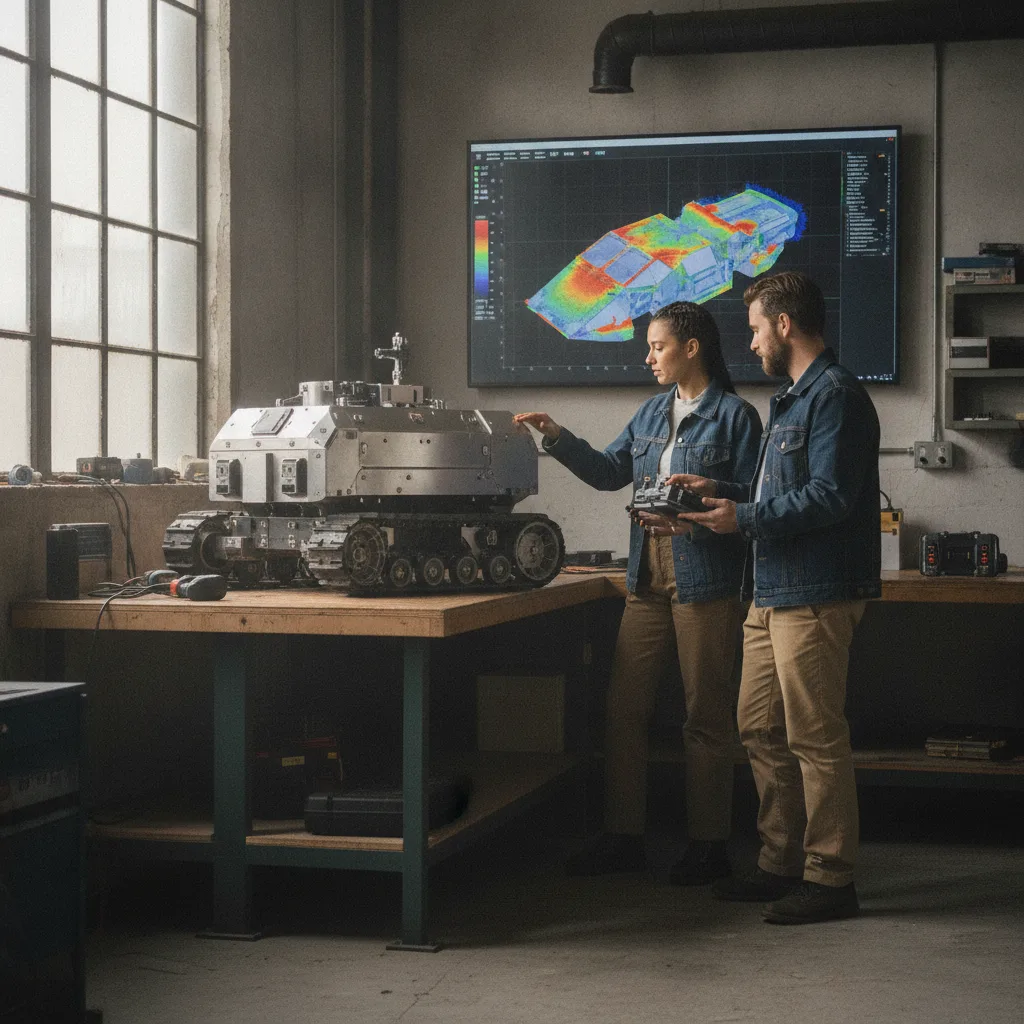
Predict stress, fatigue and modal behavior in the hull, frame and mounts of a UGV, tactical truck or trailer before you weld metal. Catch the crack-prone weld toe and the resonance that shakes a payload apart while it's still a CAD model.
Model projectile impact against composite, ceramic and layered armor to see penetration depth, spall and back-face deformation. Iterate on lay-up and thickness in simulation instead of burning through range days and armor coupons.
Simulate a buried-charge or IED event under a vehicle floor and track hull deformation, seat acceleration and occupant injury metrics. This is the analysis that turns a survivability claim into a defensible number for program reviewers.
Chasing one program often means you qualify for others you haven't heard of. These sister guides cover more of the U.S. non-dilutive landscape — same honest, no-nonsense approach. Not sure which fits what you're building? Ask us — we'll point you at the right doors, even the ones that aren't ours.
America's ~$4B/yr non-dilutive seed fund across 11 agencies.
Visit →Air Force & Space Force open topics and $3–15M matching funds.
Visit →Commercial tech to DoD via fast OTA prototype contracts.
Visit →Tipping Point, TechFlights, NIAC and the space startup ladder.
Visit →Tell us what you're building and what you're chasing. We'll tell you what funding might fit and what an Ansys eval could cover — no cost, no obligation.
